
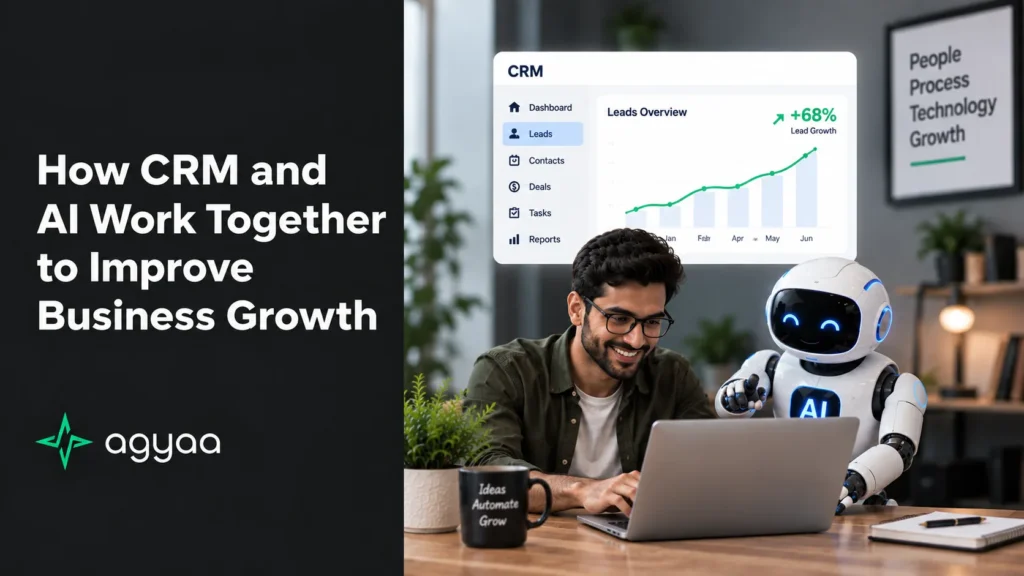
Businesses today generate more customer data than ever before. Every website visit, form submission, email, phone call, social media interaction, and purchase creates valuable information.
However, collecting customer data is not enough.
The real challenge is understanding that information and using it to make better business decisions.
This is where Customer Relationship Management systems and Artificial Intelligence can work together.
A CRM helps businesses organize customer information, manage leads, track sales activities, and improve communication. AI helps businesses analyze data, identify patterns, automate processes, and make smarter decisions.
When CRM and AI work together, businesses can create better customer experiences, improve sales performance, automate repetitive tasks, and discover new opportunities for growth.
Instead of simply storing customer information, businesses can turn that information into useful insights and actions.
Let’s explore how CRM and AI work together to improve business growth.
What Is a CRM?
A Customer Relationship Management system, commonly known as a CRM, helps businesses manage their relationships and interactions with customers and potential customers.
A CRM can store information such as:
- Customer names
- Email addresses
- Phone numbers
- Previous conversations
- Products or services purchased
- Sales activities
- Support requests
- Lead sources
- Customer preferences
This information gives businesses a clearer view of their customers.
Instead of searching through spreadsheets, emails, and different communication platforms, teams can access important customer information from one central system.
A CRM can also help businesses manage the sales process through different stages.
For example:
New Lead → Contacted → Qualified → Proposal Sent → Customer
This makes it easier for sales teams to understand where every lead is in the customer journey.
What Role Does AI Play in Business Growth?
Artificial Intelligence helps businesses process information and perform tasks that would normally require significant manual effort.
AI can analyze large amounts of data and identify patterns that may be difficult for people to notice.
For businesses, AI can help with:
- Customer behavior analysis
- Lead scoring
- Personalized communication
- Sales predictions
- Customer support
- Content generation
- Workflow automation
- Data analysis
When AI is connected with a CRM, it can use customer information to provide more useful insights.
For example, instead of simply showing a list of leads, AI can help identify which leads are most likely to become customers.
This allows sales teams to focus their attention on the right opportunities.
CRM Organizes Data While AI Makes It More Useful
A CRM collects and organizes customer information.
AI helps businesses understand what that information means.
This combination is extremely valuable.
For example, a CRM may contain information about:
- Email activity
- Website visits
- Previous conversations
- Service interests
- Purchase history
Without AI, a business may need to manually review this information.
With AI, the system can analyze customer behavior and identify important patterns.
For example:
This customer has visited your pricing page multiple times.
This lead has opened several emails but has not responded yet.
This customer may be interested in upgrading their current service.
These insights help businesses take action at the right time.
AI Helps Businesses Identify High-Quality Leads
Not every lead has the same level of interest.
Some people may simply be researching, while others may be ready to make a purchase.
AI can help businesses identify high-intent leads.
The system can analyze signals such as:
- Website visits
- Email opens
- Link clicks
- Form submissions
- Pricing page visits
- Previous conversations
- Appointment bookings
Based on these activities, AI can help assign lead scores.
For example:
Low Interest → Early Stage Lead
Medium Interest → Engaged Lead
High Interest → Sales-Ready Lead
The sales team can then focus more attention on leads that are most likely to convert.
This helps businesses use their sales resources more efficiently.
Better Personalization Through AI and CRM
Customers expect businesses to understand their needs.
Generic communication is becoming easier to ignore.
For example:
Hello Customer, check out our services.
This message does not provide much value.
Now consider:
Hi John, based on your interest in business automation, we thought you might find this information helpful.
AI and CRM systems can help businesses create more personalized communication.
Customer information can be used to personalize:
- Emails
- Follow-up messages
- Product recommendations
- Marketing campaigns
- Customer support
AI can also help determine what type of communication may be most relevant for a particular customer.
Instead of sending the same message to everyone, businesses can create experiences based on customer behavior and interests.
AI Can Improve Lead Follow-Up
Following up with leads is one of the most important parts of the sales process.
However, manual follow-up can become difficult when businesses manage a large number of leads.
CRM automation can ensure that follow-up tasks are created automatically.
AI can make this process even smarter.
For example, AI can analyze customer engagement and recommend:
- Which lead should be contacted first
- When to follow up
- What information to send
- Which communication channel may work best
Smarter Sales Predictions
Business growth requires planning.
Sales teams often need to understand:
- Which opportunities are likely to close
- Which leads require more attention
- Expected future revenue
- Potential sales risks
AI can analyze historical customer and sales data to identify patterns.
This can help businesses create better sales forecasts.
For example, AI may identify that customers with certain behaviors are more likely to become long-term customers.
Sales teams can use these insights to improve their strategy.
While AI predictions should not replace business judgment, they can provide useful information for making better decisions.
Better Customer Support with AI
Customer relationships do not end after a sale.
Providing fast and helpful customer support is essential for long-term growth.
AI and CRM systems can work together to improve customer support.
For example, when a customer contacts support, the CRM can provide information about:
- Previous conversations
- Products purchased
- Earlier support requests
- Account information
AI can then help support teams by:
- Suggesting responses
- Identifying common questions
- Categorizing requests
- Routing customers to the correct team
- Providing automated answers for simple questions
This can reduce response times.
Human support teams can then focus on complex problems that require personal attention.
AI Helps Businesses Understand Customer Behavior
Customer behavior provides valuable information.
For example, a customer may:
- Visit certain website pages
- Open specific emails
- Download resources
- Request product information
- Contact support
AI can analyze these activities and identify patterns.
This can help businesses better understand:
- What customers are interested in
- Which services are receiving attention
- Where customers lose interest
- Which marketing campaigns are working
Instead of relying only on assumptions, businesses can use customer data to improve their strategies.
Automated Customer Journeys Become Smarter
A customer journey includes every interaction between a business and a customer.
CRM automation can create workflows for different stages of this journey.
For example:
New Lead
Send a welcome message.
Interested Lead
Provide helpful information.
Qualified Lead
Schedule a sales conversation.
New Customer
Start an onboarding process.
Existing Customer
Send relevant updates and support information.
AI can improve these workflows by making them more personalized.
Instead of sending every customer through exactly the same process, AI can help businesses adjust communication based on customer behavior.
This creates a more relevant experience.
AI Helps Sales Teams Save Time
Sales teams often spend significant time on repetitive tasks.
These may include:
- Updating CRM records
- Writing follow-up messages
- Creating summaries
- Preparing reports
- Managing customer information
AI can help automate some of these tasks.
For example, AI can assist with:
- Conversation summaries
- Follow-up suggestions
- Email drafts
- Lead research
- Data organization
This gives sales professionals more time to focus on activities that require human skills.
These include:
- Building relationships
- Understanding customer problems
- Negotiating deals
- Providing recommendations
The goal is not to replace sales teams.
The goal is to make them more efficient.
Improved Marketing Through Customer Insights
Marketing becomes more effective when businesses understand their audience.
CRM data can show how customers interact with marketing campaigns.
AI can analyze this information to identify trends.
For example:
- Which emails receive the most engagement
- Which content generates leads
- Which customer segments are most valuable
- Which campaigns produce conversions
Businesses can then improve future marketing campaigns.
AI can also help create more targeted customer segments.
Instead of sending the same campaign to everyone, businesses can create communication based on different customer interests.
Customer Retention and Growth
Business growth is not only about finding new customers.
Keeping existing customers is equally important.
CRM systems help businesses track customer relationships after a sale.
AI can help identify opportunities for:
- Customer retention
- Upselling
- Cross-selling
- Customer re-engagement
For example, AI may identify a customer who has not interacted with the business for several months.
The CRM can then trigger a re-engagement campaign.
Similarly, AI may identify customers who could benefit from additional services.
This allows businesses to create more relevant growth opportunities.
AI Can Improve Business Decision-Making
Business leaders often need to make decisions based on large amounts of information.
CRM systems collect valuable customer and sales data.
AI can help analyze that information.
Businesses can use AI insights to better understand:
- Sales performance
- Customer behavior
- Marketing effectiveness
- Growth opportunities
- Potential risks
This allows businesses to make more data-driven decisions.
Instead of spending hours manually analyzing reports, teams can use AI to identify important trends.
Common Mistakes Businesses Should Avoid
While CRM and AI can provide major benefits, businesses should avoid some common mistakes.
Using Poor Customer Data
AI insights depend on data quality.
If customer information is incomplete or outdated, results may not be useful.
Automating Everything
Not every customer interaction should be automated.
Important conversations still require human communication.
Ignoring Privacy and Data Security
Businesses should handle customer information responsibly and follow relevant data protection requirements.
Using AI Without Clear Goals
Businesses should identify specific problems before implementing AI.
For example:
- Improve lead response time
- Reduce manual follow-up
- Improve customer support
- Increase conversions
Clear goals make implementation more effective.
How Businesses Can Start Using CRM and AI
Businesses do not need to completely transform their systems overnight.
A practical approach is to start with specific processes.
Step 1: Organize Customer Data
Ensure customer information is stored properly in a CRM.
Step 2: Identify Repetitive Tasks
Look for processes that consume significant time.
Step 3: Add Automation
Automate simple tasks such as:
- Lead capture
- Follow-up reminders
- Appointment confirmations
- Customer onboarding
Step 4: Introduce AI Tools
Use AI for:
- Lead scoring
- Customer insights
- Sales assistance
- Content and communication support
Step 5: Measure Results
Track important business metrics such as:
- Lead response time
- Conversion rates
- Sales performance
- Customer engagement
- Customer retention
Step 6: Continue Improving
AI and CRM systems should continue evolving as the business grows.
The Future of Business Growth Is Intelligent Automation
Businesses are moving toward more connected and intelligent systems.
CRM technology provides the foundation for managing customer relationships.
AI adds intelligence by helping businesses analyze data, identify opportunities, and automate important processes.
Together, these technologies can help businesses:
- Understand customers better
- Respond faster
- Improve lead conversion
- Personalize communication
- Support sales teams
- Improve customer retention
- Make smarter business decisions
The future will not simply be about collecting more customer data.
It will be about using that data intelligently.
Final Thoughts
CRM and AI are powerful individually.
A CRM helps businesses organize customer information and manage relationships.
AI helps businesses analyze information and make smarter decisions.
When these technologies work together, businesses can create more efficient systems and better customer experiences.
The biggest advantage is not simply automation.
It is the ability to understand customers and take action based on real information.
From lead generation and sales to customer support and retention, CRM and AI can improve almost every stage of the customer journey.
Businesses that combine customer data, automation, AI insights, and human relationships can create smarter systems for long-term growth.
The future of business growth is not about working harder to manage more customers.
It is about using intelligent technology to create better experiences, stronger relationships, and more opportunities.