
For decades, the inbound telephone call has remained one of the highest-converting communication channels in sales. When a prospective buyer picks up the phone to dial a business, they exhibit an exceptionally high level of intent. They are not casually skimming a blog or scrolling through social feeds; they have an immediate problem, an urgent inquiry, or an active buying decision to make right now.
Yet, despite the high intent of inbound callers, conventional voice sales channels remain deeply flawed. Human call centers face operational bottlenecks: severe staffing shortages, high employee turnover rates, unpredictable call spikes, prohibitive overhead costs, and strict business-hour limitations. When buyers encounter long hold times, frustrating interactive voice response (IVR) button trees, or unmonitored voicemail boxes after hours, they rarely wait—they hang up and call a direct competitor.
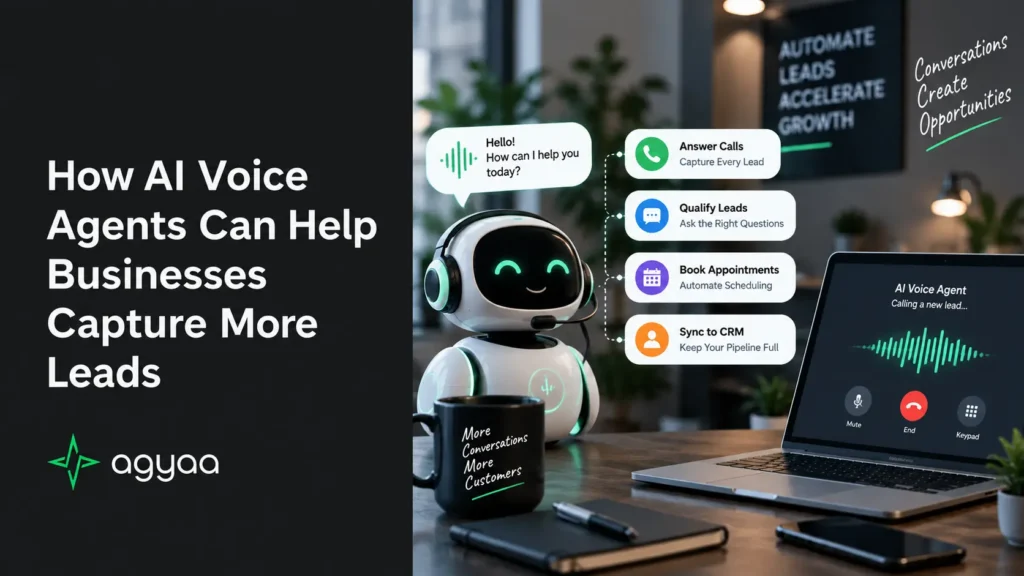
Enter AI Voice Agents. Powered by advanced Natural Language Processing (NLP), dynamic Speech-to-Text (STT), large language models (LLMs), and hyper-realistic Text-to-Speech (TTS) synthesis, modern AI voice agents conduct natural, human-like, two-way spoken conversations at scale. Unlike basic phone menus, AI voice bots act as autonomous, highly skilled conversational agents that engage callers instantly, qualify prospects in real time, answer complex inquiries, and schedule appointments directly into your calendar. Below is an in-depth operational analysis of how AI voice agents empower modern enterprises to capture, qualify, and convert more leads than ever before.
Key Industry Benchmarks
- 67% of Callers: Hang up forever and never leave a message when sent to an after-hours voicemail.
- 0 Seconds: The average wait time when utilizing autonomous AI voice systems.
- 300%+ Increase: In after-hours lead capture rates following AI voice agent implementation.
1. The Shift from Traditional IVR to AI Voice Agents
To understand the transformative power of AI voice agents, it is critical to contrast them with legacy IVR systems. Traditional phone trees rely on rigid decision trees (“Press 1 for Sales, Press 2 for Billing”) that frustrate callers and offer zero conversational value. AI voice agents eliminate this friction completely.
| Feature / Capability | Legacy IVR Systems | Modern AI Voice Agents |
| User Interaction | DTMF keypads (“Press 1”) or rigid voice commands. | Free-form, natural spoken dialogue with contextual understanding. |
| Handling Interruptions | Fails if user speaks out of turn or changes topic. | Gracefully handles interruptions (barge-in) and topic pivots. |
| Lead Qualification | None; routes call to a human queue. | Asks dynamic qualifying questions and scores leads in real time. |
| Data Capture | Basic call duration and caller ID logging. | Transcribes, summarizes, and extracts metadata into CRM automatically. |
| Availability & Scale | Limited by human operator seat capacity. | Infinite concurrent scalability with zero hold times, 24/7/365. |
2. 24/7 Immediate Lead Response: Eliminating Hold Times & Missed Calls
The primary reason businesses lose phone leads is simple timing. High-intent prospective buyers do not limit their inquiries to standard 9-to-5 operating hours. They make inquiries during evening commutes, on weekends, and late at night. When an after-hours call reaches voicemail, up to two-thirds of prospects never leave a message—they immediately dial the next business on Google.
AI voice agents provide complete, continuous operational coverage. Every call is answered on the very first ring, regardless of the time of day or night. By engaging callers instantly, AI voice agents satisfy the buyer’s need for immediate gratification and lock in their intent before they explore alternative providers.
Strategic Advantage: By guaranteeing zero wait times and 24/7 availability, businesses instantly recapture the estimated 30% to 45% of potential leads that are typically lost to voicemail or dropped calls after operating hours.
3. Intelligent Real-Time Lead Qualification
Answering the call is only the first step; determining whether the caller represents a viable commercial opportunity is equally crucial. Human sales teams waste hundreds of hours every month speaking with unqualified leads, spam callers, or job seekers.
AI voice agents execute structured, intelligent qualification protocols naturally during conversation. Guided by customizable conversational frameworks, the AI agent dynamically asks critical qualifying questions:
- Budget & Investment Level:“What budget range have you allocated for this project?”
- Project Timeline:“How soon are you looking to begin implementation?”
- Authority & Need:“Are you evaluating solutions for your entire organization, or a specific department?”
- Geographic / Vertical Fit:“Where is your property or headquarters located?”
Based on the caller’s natural answers, the AI agent dynamically calculates a qualification score. High-value leads are instantly prioritized, while out-of-scope inquiries are politely redirected or provided with self-service resources.
4. Frictionless Live Call Transfers & Self-Scheduling
Once an inbound lead is qualified, speed to final booking becomes the key conversion driver. AI voice agents eliminate friction at the point of handoff through two primary mechanisms:
Live Call Routing & Hot Transfers
If a qualified lead calls during business hours and requests immediate assistance, the AI agent executes an automated transfer directly to an available sales representative’s phone or browser queue, delivering a brief audio summary of the lead’s context to the rep before bridging the call.
Automated Direct Calendar Booking
When high-value prospects call after hours or sales reps are occupied, the AI voice agent accesses team calendar systems (e.g., via Google Calendar or Outlook APIs) in real time. The agent negotiates meeting slots conversationally (“I have openings tomorrow at 2:00 PM or Thursday at 10:00 AM. Which works best for you?”) and books the demo or consultation directly onto the rep’s schedule, complete with automated SMS confirmation invites.
5. Instant Multi-Touch Follow-Up and Outbound Lead Outreach
While inbound call handling is a primary use case, AI voice agents are equally powerful in driving rapid outbound lead engagement. Research shows that contacting a web form lead within 60 seconds yields the highest possible conversion rates.
When a prospective client submits a high-intent web form, quote request, or Facebook lead ad, the CRM can trigger an AI voice agent to launch an outbound call within seconds:
Example Outbound Scenario:“Hi Sarah, I saw you just requested a home valuation quote on our website. I’m calling to quickly answer any initial questions you have and get a few details to finalize your report. Do you have two minutes?”
This rapid multi-touch approach captures the buyer’s attention while your brand is fresh in their mind, drastically outperforming manual callback processes that often take hours or days.
6. Seamless CRM Integration and Zero Administrative Overhead
One of the biggest leaks in traditional sales operations is manual data entry. Human reps routinely forget to log call notes, misspell contact details, or omit crucial buyer preferences from the CRM.
AI voice agents operate as direct extensions of your tech stack. Through deep integrations with CRMs like HubSpot, Salesforce, and Zoho, every single call yields instant, structured data outputs:
- Full Audio Recordings & Transcripts: Exact word-for-word conversation logs appended to the contact record.
- AI-Generated Summaries: Concise key takeaway bullet points generated instantly post-call.
- Field Mapping & Metadata Extraction: Automatic updating of custom CRM fields (e.g., job title, budget, pain points, requested service date).
- Automated Post-Call Triggers: Immediate dispatch of follow-up SMS messages, email confirmations, or internal Slack/Teams notifications to assigned account managers.
7. Scaling Sales Operations with Reduced Costs
Building a 24/7 human voice operations team requires substantial financial resources: salaries, benefits, call center infrastructure, management oversight, and ongoing training. As inbound call volume scales, linear cost increases become unsustainable.
AI voice agents provide exponential scalability at a fraction of the cost. A single AI voice architecture can effortlessly handle thousands of simultaneous phone calls without performance degradation, seasonal bottlenecks, or added headcount costs. This enables businesses to scale marketing campaigns aggressively, confident that every generated inbound call will be answered and qualified flawlessly.
8. Industry-Specific Implementations
AI voice agents adapt seamlessly across diverse high-intent industries:
- Real Estate & Property Management: Answer inquiry calls on property listings, collect buyer preferences, prescreen financing readiness, and schedule property walkthroughs.
- Home Services & Contracting: Handle emergency dispatch calls, capture job scope details, provide preliminary estimate ranges, and book service technician appointments.
- Healthcare & Medical Practices: Triage patient inquiries, capture insurance information, verify appointment eligibility, and schedule consultations in full compliance with privacy standards.
- B2B Software & Professional Services: Qualify incoming demo requests, verify company size and budget, and route enterprise leads to senior account executives.
Conclusion: The Competitive Imperative of AI Voice
In a marketplace defined by rapid digital interactions, voice communication remains the most direct line to high-intent prospective customers. However, relying on traditional human staffing models or legacy IVR menus inevitably leaves money on the table through missed calls, long hold times, and delayed follow-ups.
AI voice agents bridge the critical gap between human touch and digital efficiency. By providing 24/7 instantaneous answers, intelligent real-time qualification, direct calendar bookings, and automated CRM data enrichment, AI voice technology ensures that your enterprise captures every high-intent lead that dials your business—transforming phone channels into predictable, scalable revenue engines.