
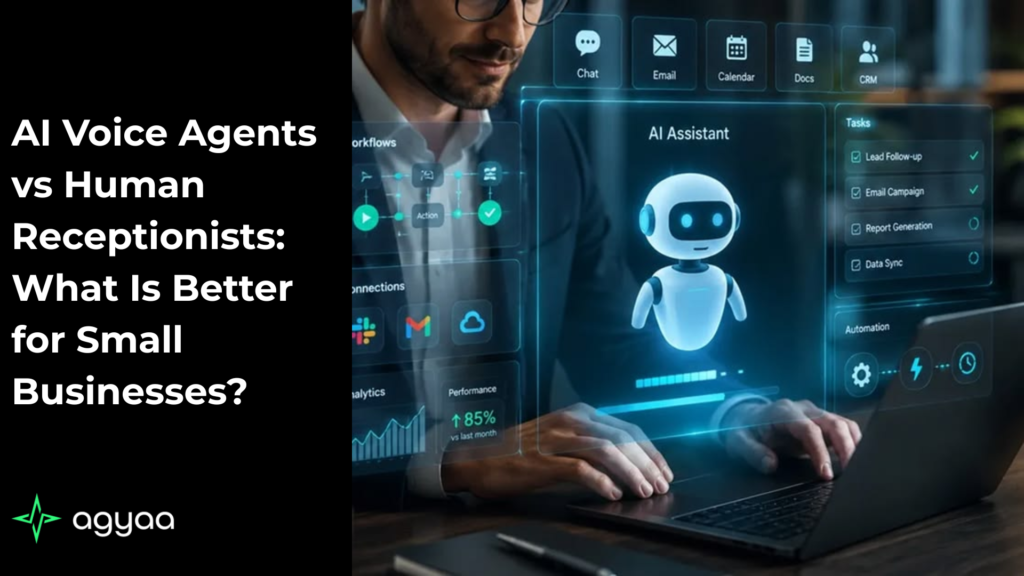
Small businesses often lose potential customers when calls go unanswered, appointments are missed, or inquiries arrive outside business hours. Hiring a full-time receptionist can help, but it may not fit every business’s budget or operational needs. This is where AI voice agents offer another option.
For businesses comparing traditional customer support with automation, the choice depends on call volume, customer expectations, budget, and the complexity of daily interactions. The right CRM software for small business can also help connect calls, customer information, appointment scheduling, and follow-ups in one organised system.
What Are AI Voice Agents?
AI voice agents are AI-powered systems that communicate with customers through spoken conversations. Depending on their configuration, they can answer incoming calls, respond to common questions, collect customer details, qualify leads, and help schedule appointments.
For example, a US salon could use an AI voice agent to answer questions about available services, collect a caller’s preferred appointment time, and direct the customer toward booking.
When integrated with CRM software, the system can also record relevant information, update contact records, and trigger follow-up workflows.
AI voice agents are especially useful for repetitive, predictable interactions. However, their capabilities depend on the technology, integrations, and workflows configured for the business.
What Does a Human Receptionist Offer?
A human receptionist provides personal interaction, emotional understanding, and flexibility when handling unexpected situations. They can interpret context, reassure frustrated customers, manage unusual requests, and make decisions that require human judgement.
For businesses where trust and personal attention are central to the customer experience, a receptionist can play an important role.
However, human receptionists have practical limitations. They can handle only a certain number of calls at once, require breaks, and may not be available outside scheduled working hours. Hiring additional staff to extend coverage can also increase operating costs.
AI Voice Agents vs Human Receptionists: Key Differences
| Feature | AI voice agents | Human receptionists |
|---|---|---|
| Availability | Can provide extended or 24/7 coverage when configured | Depends on working hours and staffing |
| Call handling | Can handle repetitive calls and multiple interactions according to system capacity | Provides personal attention, but capacity is limited |
| Customer experience | Consistent for supported tasks | More adaptable to complex conversations |
| Appointment scheduling | Can assist with connected booking systems | Can manage bookings manually or through software |
| Lead qualification | Can ask predefined questions and collect information | Can explore customer needs with greater flexibility |
| Operating costs | Subscription, usage, setup, and integration costs may apply | Wages, benefits, training, and other employment costs may apply |
| Complex situations | May require escalation to a person | Better suited to nuanced judgement and sensitive interactions |
Neither option is automatically better for every business. The decision should reflect how customers contact the business and what they expect from the first conversation.
How CRM Software for Small Business Improves Both Options?
Choosing between AI and human support is only part of the process. Businesses also need a reliable way to organise customer information and manage the next steps after each call.
Effective CRM software for small business can connect communication with lead management, appointment booking, and follow-up automation.
For example, a service business can use its CRM to:
- Store customer details and interaction history.
- Organise new inquiries in a sales pipeline.
- Assign qualified leads to the appropriate team member.
- Send appointment confirmations and reminders.
- Trigger follow-ups when a prospect has not booked.
- Track inquiries, appointments, and conversion rates.
With a connected CRM, an AI voice agent can handle suitable initial inquiries while employees focus on consultations, customer relationships, and more complex requests.
This creates a more coordinated process instead of treating every call as a separate task.
Which Businesses Should Consider AI Voice Agents?
AI voice agents can be particularly useful for small businesses that receive frequent calls and handle recurring questions.
- Salons and spas: Answer service inquiries, assist with appointment requests, and direct customers to booking options.
- Home-service businesses: Collect details about plumbing, HVAC, electrical, or cleaning jobs and organise inquiries for follow-up.
- Real estate agencies: Capture buyer and seller inquiries and collect basic property requirements.
- Coaches and consultants: Gather information from prospective clients and help schedule discovery calls.
- Fitness studios: Respond to membership inquiries and guide prospects toward consultations or trial sessions.
Businesses with highly sensitive conversations or complex customer needs may benefit from a hybrid approach that combines AI support with human assistance.
Is a Hybrid Receptionist Model Better?
For many small businesses, combining AI voice agents with human receptionists offers a practical middle ground.
AI can manage routine inquiries, collect initial information, and support appointment scheduling. Human employees can then handle complicated requests, sensitive conversations, negotiations, and customers who specifically want personal assistance.
To implement this approach, businesses should define which calls the AI can handle, when escalation is necessary, and how customer information will be transferred to the team.
They should also test call flows, calendar availability, data accuracy, and follow-up workflows before launching the system.
Businesses using automated calls or related messaging should review applicable consent, disclosure, privacy, and telemarketing requirements.
Frequently Asked Questions
Are AI voice agents better than human receptionists?
AI voice agents are useful for routine inquiries, extended availability, and repetitive tasks. Human receptionists are better suited to nuanced conversations and situations requiring personal judgement. The best choice depends on business needs.
How much does an AI voice agent cost for a small business?
Costs vary by provider, call volume, usage, integrations, and setup requirements. Businesses should compare the total cost of ownership with their current staffing needs rather than relying on subscription price alone.
Can AI voice agents work with CRM software?
Yes. Compatible integrations can connect voice interactions with CRM contact records, lead qualification, appointment scheduling, and follow-up workflows. Available features depend on the selected platform and configuration.
Should a small business replace its receptionist with AI?
Not necessarily. A hybrid model can automate repetitive tasks while retaining human support for complex interactions. Businesses should assess customer expectations and performance before making staffing changes.
Final Verdict: Which Option Is Better?
AI voice agents are a strong option for businesses that want to manage routine calls, capture leads, and support appointment scheduling beyond standard working hours. Human receptionists remain valuable for personal service, complex conversations, and situations requiring judgement.
For many small businesses, the most practical solution is to combine AI voice agents with reliable CRM software for small business. This approach helps organise customer information, coordinate follow-ups, and create a smoother experience from the first call to the next business interaction.
Ready to simplify your customer communication? Explore Agyaa to discover how AI-powered CRM and automation can help your business manage leads, appointments, and follow-ups more efficiently.