
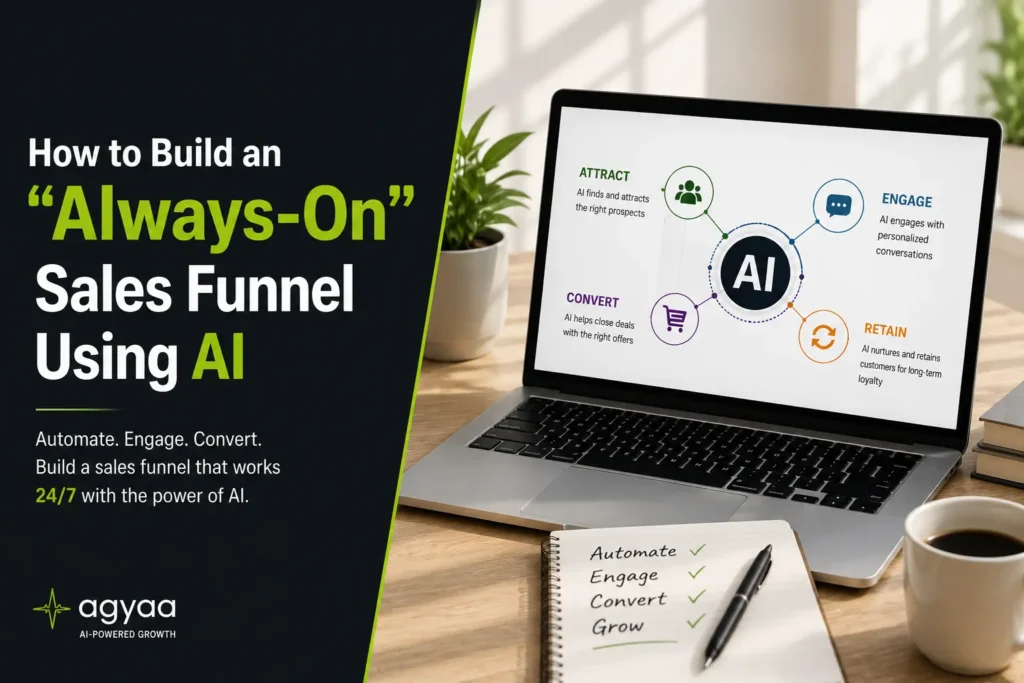
Customers do not follow a fixed buying schedule. They may search for your product at midnight, visit your website during the weekend, compare your services with competitors, or return several times before making a decision. If your sales process only works when your team is online, you are likely losing potential leads.
This is where an always-on sales funnel can make a difference.
With Artificial Intelligence (AI), businesses can automate key parts of the customer journey, including lead generation, customer engagement, follow-ups, lead qualification, and personalization. The goal is not to replace your sales team. Instead, AI helps your business stay active and responsive even when no one is manually managing every interaction.
Here is how you can build an always-on sales funnel using AI.
1. Attract the Right Audience
A sales funnel starts with attracting potential customers. However, getting more website traffic is not enough. You need to attract people who are genuinely interested in what you offer.
AI can help analyze search trends, customer behavior, keywords, and audience interests. This information can be used to create more relevant:
- Blog content
- Landing pages
- Social media posts
- Paid advertisements
- Product descriptions
- Email campaigns
For example, AI can help identify the questions your target customers are searching for online. You can then create content that answers those questions and naturally introduces your product or service as a solution.
The more relevant your content is to the customer’s search intent, the better your chances of bringing qualified prospects into the funnel.
2. Capture Leads With Smart Landing Pages
Once someone visits your website, you need to give them a reason to take the next step.
This could include downloading a guide, booking a consultation, requesting a quote, starting a free trial, or subscribing to your newsletter.
AI can help improve landing page performance by analyzing visitor behavior and identifying which messages or offers generate better engagement.
Instead of showing every visitor the same message, you can also personalize the experience. A first-time visitor may need basic information, while someone who has already visited your pricing page may be ready for a stronger call to action.
Small improvements in personalization can help move visitors through the funnel more effectively.
3. Use AI Chatbots for 24/7 Engagement
One of the most useful parts of an always-on funnel is instant communication.
When visitors have questions, they usually want answers immediately. If they cannot find the information they need, they may leave and never return.
AI chatbots can engage visitors 24/7 and help them take the next step.
A chatbot can:
- Answer common questions
- Explain products or services
- Recommend relevant solutions
- Collect contact details
- Qualify leads
- Schedule demos or appointments
- Send complex queries to a human team member
For example, if someone visits your website and asks about pricing, the chatbot can provide the relevant information and guide them toward booking a consultation.
This keeps the conversation moving instead of making the customer wait for a manual response.
4. Automatically Qualify Your Leads
Not every lead is ready to buy immediately.
Some visitors are only researching, while others may already be comparing prices and looking for the right solution. AI can analyze customer activity and help identify which leads are more likely to convert.
It can consider actions such as:
- Pages visited
- Number of website visits
- Forms submitted
- Emails opened
- Products viewed
- Content downloaded
- Previous conversations
Based on this activity, leads can be prioritized.
For example, someone who reads a single blog post may need more educational content. On the other hand, someone who visits your pricing page multiple times and requests a demo may be ready for direct contact from your sales team.
This helps sales professionals focus their time on high-intent prospects.
5. Automate Personalized Follow-Ups
Most people do not become customers during their first visit.
They may need more information, time to compare options, or additional trust before making a decision. This is why follow-up is one of the most important parts of a sales funnel.
AI can automate follow-up messages based on customer actions.
For example:
- A visitor downloads a guide → Send related educational content.
- A customer views a product but does not purchase → Send a reminder.
- A lead requests information → Share a relevant case study.
- A prospect visits your pricing page → Offer a demo or consultation.
Instead of sending the same email to every lead, AI can help make communication more relevant to the customer’s stage in the buying journey.
The key is to make follow-ups useful rather than repetitive.
6. Connect AI With Your CRM
For an always-on sales funnel to work properly, customer data should not remain scattered across different tools.
Your website, chatbot, email platform, and sales process should connect with your CRM.
This allows you to create a clearer picture of every lead.
When a salesperson contacts a prospect, they can see important information such as:
- Which pages the prospect visited
- What content they downloaded
- Which emails they opened
- Questions they asked through the chatbot
- Products or services they showed interest in
This makes sales conversations more relevant and reduces unnecessary back-and-forth.
7. Re-Engage Leads That Do Not Convert
Not every visitor will convert immediately, but that does not mean the opportunity is lost.
AI can help identify leads that showed interest but stopped engaging with your business. You can then create automated campaigns to bring them back.
For example, a potential customer who visited your website but did not complete a purchase can receive a relevant reminder. Someone who downloaded a resource but never responded to follow-up emails can be added to a different nurturing campaign.
Retargeting works best when the message matches the customer’s previous behavior.
Rather than simply saying, “Come back and buy,” provide something useful that helps them move closer to a decision.
8. Continuously Improve the Funnel
An AI-powered funnel is not something you set up once and forget forever.
You should regularly review your funnel performance and identify where potential customers are dropping off.
Important metrics include:
- Website conversion rate
- Number of qualified leads
- Email engagement
- Cost per lead
- Lead-to-customer conversion rate
- Customer acquisition cost
AI can help analyze this data and identify patterns that may be difficult to spot manually.
For example, you may discover that a particular landing page receives plenty of traffic but generates very few leads. Or you may find that prospects stop engaging after a specific email.
These insights allow you to test and improve the funnel over time.
Final Thoughts
Building an always-on sales funnel with AI is about creating a system that continues to attract, engage, nurture, and qualify leads around the clock.
Start by identifying the biggest gaps in your current sales process. Maybe leads are waiting too long for responses, follow-ups are inconsistent, or your sales team is spending too much time qualifying prospects.
AI can help solve these problems by automating repetitive tasks and delivering more personalized customer experiences.
The best approach is to start small, measure the results, and gradually expand AI across your sales funnel. When used strategically, AI can help you build a more efficient sales process that works continuously and gives your team more time to focus on closing the right opportunities.