
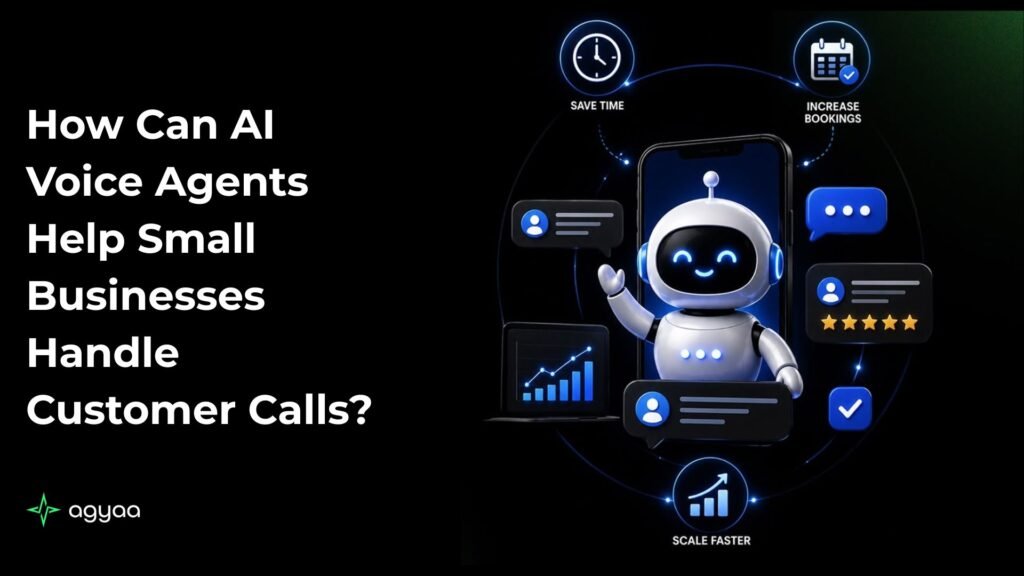
Managing customer calls can be challenging for small businesses, especially when staff members are busy serving customers, handling appointments, or managing daily operations. Missed calls can lead to lost sales opportunities and poor customer experiences.
AI voice agents offer a practical solution by answering phone calls, responding to common questions, collecting customer information, and helping schedule appointments automatically. With AI-powered communication tools like Agyaa, businesses can explore ways to streamline customer interactions and improve operational efficiency.
What Are AI Voice Agents?
AI voice agents are intelligent virtual assistants that communicate with customers over the phone using conversational artificial intelligence. They can understand spoken questions, provide relevant responses, and perform specific tasks based on their configuration and integrations.
Unlike traditional phone systems that rely on fixed menus, conversational AI voice agents can handle natural-language interactions and guide callers toward the information or service they need.
For small businesses, these agents can support customer service, lead qualification, appointment scheduling, and routine call management.
7 Ways AI Voice Agents Help Small Businesses Handle Customer Calls
1. Answer Customer Calls Around the Clock
Small businesses may not have enough staff to answer every call during busy periods or outside regular working hours. AI voice agents can provide extended call coverage, depending on their configuration, helping customers get answers when employees are unavailable.
For example, a potential customer calling a salon after closing could ask about services, pricing, or appointment availability.
2. Reduce Missed Sales Opportunities
Every unanswered call could represent a potential customer contacting a competitor instead. AI voice agents can answer incoming calls, collect contact details, understand customer needs, and route qualified inquiries to the appropriate team.
This helps businesses capture more opportunities without requiring employees to answer every routine call manually.
3. Automate Appointment Scheduling
Appointment-based businesses often spend considerable time coordinating bookings and answering availability questions.
When connected to a scheduling system, an AI voice agent can help callers find suitable appointment times, create bookings, and provide relevant confirmation details.
This can benefit salons, fitness studios, consultants, healthcare practices, and other service-based businesses. Actual booking capabilities depend on the integrations available.
4. Handle Frequently Asked Questions
Customers frequently call businesses to ask about opening hours, services, location, pricing, and booking procedures.
AI voice agents can answer common questions using approved business information. This reduces repetitive work for employees and allows them to focus on more complex customer needs.
Businesses should regularly review their AI agent’s information to ensure that answers remain accurate and up to date.
5. Improve Lead Qualification and Follow-Ups
AI voice agents can ask callers relevant questions to understand their requirements, budget, service preferences, or purchase timeline.
With suitable CRM integration, the collected information can be recorded against a lead profile so the sales team can prioritize inquiries and follow up more effectively.
For example, a real estate business could use an AI voice agent to gather a caller’s preferred location, property type, and budget before passing the inquiry to an agent.
6. Reduce Routine Workloads and Operating Costs
Hiring additional staff to manage every incoming call may not be practical for a growing small business.
AI voice agents can handle certain repetitive interactions simultaneously, depending on the provider’s capacity and configuration. This can reduce the amount of time employees spend on routine calls while allowing human staff to focus on customer relationships and more complicated requests.
The actual cost savings depend on call volume, pricing, integration costs, and the types of tasks automated.
7. Deliver More Consistent Customer Experiences
AI voice agents can follow predefined workflows, use consistent business information, and guide callers through standardized processes.
Businesses can also configure escalation rules so that callers can reach a human employee when they have complex questions, urgent concerns, or requests the AI cannot handle reliably.
Combining automation with human support helps businesses maintain a more dependable customer service experience.
Which Small Businesses Can Benefit from AI Voice Agents?
AI voice agents can support many industries where telephone inquiries, bookings, and customer communication are important.
- Salons and spas: Answer service inquiries and help customers book appointments.
- Real estate agencies: Collect property requirements and qualify prospective buyers or tenants.
- Fitness studios: Respond to membership questions and explain class schedules.
- Home service providers: Gather information about plumbing, electrical, cleaning, or repair requests.
- Consultants and coaches: Handle initial inquiries and coordinate consultations.
- Retail businesses: Answer questions about store hours, products, and basic policies.
The most suitable use cases depend on call volume, customer expectations, and the complexity of each business’s services.
AI Voice Agents vs. Traditional Call Handling
| Feature | Traditional call handling | AI voice agents |
|---|---|---|
| Availability | Depends on staffing and business hours | Can offer extended availability |
| Routine questions | Answered by employees | Can be automated |
| Simultaneous calls | Limited by staff capacity | Depends on system capacity |
| Appointment booking | Often handled manually | Can be automated with integration |
| Lead collection | Requires manual entry or processes | Can collect and transfer information |
| Complex requests | Handled by employees | May require human escalation |
AI voice agents are not a complete replacement for human support. Instead, they can complement employees by managing suitable routine interactions and directing more complex requests to the right person.
How to Choose the Right AI Voice Agent for Your Small Busines?
Before implementing an AI voice agent, consider these important factors:
- Natural conversations: Choose a system that can understand common customer questions and respond clearly.
- CRM integration: Check whether call details and customer information can be transferred to your CRM.
- Appointment scheduling: Verify whether the agent can access availability and create bookings when needed.
- Call transfers: Ensure callers can reach a human when necessary.
- Reporting and analytics: Look for call summaries, lead records, and performance reporting.
- Privacy and security: Understand how calls, recordings, transcripts, and customer information are handled.
- Pricing and scalability: Compare subscription fees, usage charges, integration costs, and expected call volumes.
Start with a limited set of common questions or booking workflows, measure the results, and expand automation as the system proves reliable.
How Agyaa Can Fit into Your Customer Communication Strategy?
Agyaa is a platform to explore for businesses interested in AI-powered customer communication and automation. Small businesses evaluating Agyaa should review its current voice-agent capabilities, available CRM integrations, scheduling features, and supported workflows to determine whether they meet their requirements.
Explore the platform to learn more about its available solutions.
By connecting call handling with lead management and follow-up processes, businesses can work toward a more organized customer journey—from the first inquiry to a confirmed appointment and ongoing customer relationship.
Frequently Asked Questions (FAQs)
1. How do AI voice agents help small businesses?
AI voice agents help small businesses answer routine calls, respond to frequently asked questions, collect lead information, support appointment scheduling, and route complex inquiries to employees. Their capabilities depend on the software and integrations used.
2. Can AI voice agents answer calls 24/7?
Many AI voice agents can operate outside regular business hours and provide round-the-clock call coverage. Availability depends on the provider’s service, configuration, and telephony setup.
3. Can AI voice agents book appointments automatically?
Yes, AI voice agents can schedule appointments when they are integrated with a compatible booking system and configured with the necessary permissions and workflows.
4. Are AI voice agents suitable for small businesses?
Yes. They can be useful for small businesses that receive frequent inquiries, manage appointments, or need help capturing leads. Businesses should assess affordability, call complexity, and customer preferences before implementation.
5. Can AI voice agents integrate with CRM software?
Some AI voice agents integrate with CRM platforms to save customer details, record interactions, update lead information, and support follow-up workflows. Integration capabilities vary by provider.
6. Will AI voice agents replace customer service employees?
AI voice agents are generally most useful for automating routine tasks and supporting employees. Human staff remain important for sensitive situations, complex problems, exceptions, and interactions requiring judgment or empathy.
Conclusion
AI voice agents can help small businesses handle customer calls more efficiently by automating routine conversations, supporting appointment scheduling, capturing leads, and improving call availability. When combined with CRM software and clear escalation processes, they can help businesses organize customer communication while allowing employees to focus on higher-value work.
For small businesses exploring AI-powered customer management, Agyaa is worth evaluating alongside other solutions to identify the features and integrations that best match their needs.